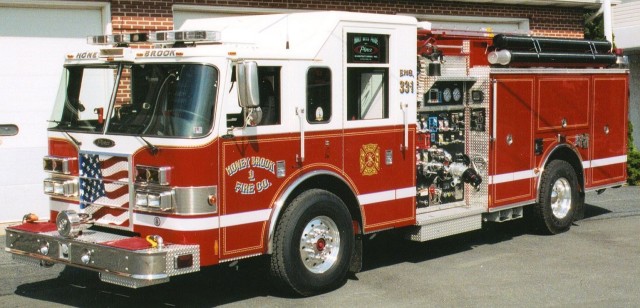
Why are Fire Trucks Red?
The most widely-accepted reason that fire engines are painted red dates back to the 1800s -- a time when there was a lot of competition between the fire brigades of neighboring cities and towns. The firefighters of each brigade took great pride in their pump. Each brigade wanted their rig stand out by being the cleanest, having the most brass, or being a regal color. Because red was the most expensive color, that's what color most crews chose to paint the pump.
Other sources cite the tradition of painting fire engines red going back to the early 1920's. Henry Ford wanted to make cars as inexpensively as possible and only offered cars in one color: black. With all of these black vehicles on the road, the fire service began painting their vehicles red in an effort to stand out.
Today, just as you have many more choices of colors available to you for your vehicle, so do the fire engine manufacturers, and it is not uncommon to see white, yellow, blue, orange, green, or even black fire engines, in addition to red. And while some studies hint that colors such as lime-green may be more visible to the public than traditional red, the vast majority of fire departments continue to use red fire engines -- a color instantly recognized by everyone as that of a fire engine.
History of Firefighting
In the centuries gone by fire has been looked upon by some peoples as a god, to be worshipped. Destructive conflagrations have been accepted as the angry expression of a deity. But with the progress of civilization the attitude toward fire has developed the philosophy that it is a splendid servant but a dangerous master."
"The history of portable fire fighting apparatus is an interesting panorama of mechanical progress. It has been a long step mechanically, as well as in terms of years, from the earthen buckets to the modern pumping engine."
"Ancient efforts at fire extinction were confined to the use of earthen, metal or leather buckets for carrying water and throwing it on the fire. The first mechanical device for fire extinction was a syringe. In England in the sixteenth century it was known as a "hand squirt." These "squirts" were of very limited effectiveness for their capacity was only about two to four quarts of water, and usually three men were required to operate them -- two to hold the cylinder and one to work the plunger. Other people were of course needed to carry the water."
"Sometime about the middle of the sixteenth century a "fire engine" was built, consisting of a giant syringe having a capacity of perhaps a barrel of water, mounted on a two-wheeled carriage. The plunger, or piston, was controlled by turning a crank attached to a threaded plunger-rod. Water was poured from buckets into the syringe through a funnel near its mouth."
"Then came the "pump engine" - a plunger pump set in a large tub of water. Two men operated the pump handle and another directed the jet of water. In order to transport this "engine" it was mounted on a sled and dragged by ropes to the fire."
"This machine was more effective than the "hand squirts" because of its greater capacity, but its effectiveness was impaired because of the interrupted action of the jet. Water was projected in spurts, ceasing with the completion of the piston stoke. As a consequence, considerable water was wasted in falling between the engine and the fire. That disadvantage was greatly overcome later by connecting two such pumps to one discharge pipe, and operating the pumps alternately. But even this machine had its limitation, and much reliance was still placed on buckets and "hand squirts".
"In the course of time there was developed the "man-power" pumping engine with the rocking handle operated by two or more men, and mounted on a four-wheeled carriage drawn by men. This type of engine, which was improved upon from time to time, was used a great many years. A few pieces of this type are still in existence."
"The next mechanical device of importance for use in fire extinction was the steam pumping engine, drawn by horses. Its advent marked considerable progress in fire fighting equipment and though the first of such engines was crude, yet the idea was developed to a point where the "steamer" possessed a high degree of efficiency. For years it served very capably in fire extinction."
"The idea of using the gasoline engine to both transport fire apparatus and to furnish power for the pump was approached from two directions; one, from the use of the gasoline engine as a transporting power only and the other from its being used only to drive the pump."
"About 1908 a pumping engine consisting of a piston pump driven by a four-cylinder gasoline engine was built. This was mounted on a vehicle drawn by horses. This "pioneer" apparatus proved the practicability of using the gasoline engine for furnishing power for a fire department pump."
"To adapt the gasoline engine to performing the double duty of transporting the apparatus and of driving the pump was soon accomplished. From that time, eventual motorization of fire departments was a certainty. It was then a matter of improving upon the principle whose inherent practicability had been demonstrated. Efforts at increasing the efficiency of the early motorized pumping engines included a study of the various types of pumps in order to ascertain which one of the three types could best be adapted to use with the gasoline engine. The three types were: the piston pump, the rotary gear pump, and the centrifugal pump. The factors entering into the suitability of these types of pumps for gasoline engine drive are discussed elsewhere in this book."
"It has been a long step mechanically, as well as in terms of years, from the ancient bucket to the modern pumping engine. Who can say but that this transition is an accurate indication of the increased intelligence of the human family?"
History of the Maltese Cross
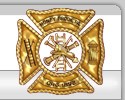
The badge of a fireman is the Maltese Cross. This Maltese Cross is a symbol of protection and a badge of honor. Its story is hundreds of years old. When a courageous band of crusaders known as the Knights of St. John, fought the Saracens for possession of the holy land, they encountered a new weapon unknown to European warriors. It was a simple, but a horrible device of war, it wrought excruciating pain and agonizing death upon the brave fighters for the cross. The Saracen's weapon was fire. As the crusaders advanced on the walls of the city, they were struck by glass bombs containing naphtha. When they became saturated with the highly flammable liquid, the Saracens hurled a flaming torch into their midst. Hundreds of the knights were burned alive; others risked their lives to save their brothers-in-arms from dying painful, fiery deaths.
Thus, these men became our first firemen and the first of a long list of courageous firefighters. Their heroic efforts were recognized by fellow crusaders who awarded each here a badge of honor - a cross similar to the one firemen wear today. Since the Knights of St. John lived for close to four centuries on a little island in the Mediterranean Sea named Malta, the cross came to be known as the Maltese Cross.
The Maltese Cross is your symbol of protection. It means that the fireman who wears this cross is willing to lay down his life for you just as the crusaders sacrificed their lives for their fellow man so many years ago.
The Maltese Cross is a fireman's badge of honor, signifying that he works in courage -a ladder rung away from death.
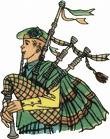
Bagpipes
The tradition of bagpipes played at fire department and police department funerals in the United States goes back over one hundred fifty years. When the Irish and Scottish immigrated to this country, they brought many of their traditions with them. One of these was the bagpipe, often played at Celtic weddings, funerals and ceilis (dances).
It wasn't until the great potato famine and massive Irish immigration to the East Coast of the United States that the tradition of the bagpipes really took hold in the fire department. In the 1800's, Irish immigrants faced massive discrimination. Factories and shops had signs reading "NINA" - No Irish Need Apply. The only jobs they could get were the ones no one else wanted - jobs that were dirty, dangerous, or both - firefighters and police officers. It was not an uncommon event to have several firefighters killed at a working fire. The Irish firefighters' funerals were typical of all Irish funerals - the pipes were played. It was somehow okay for a hardened firefighter to cry at the sound of bagpipes when his dignity would not let him weep for a fallen comrade.
Those who have attended a funeral where bagpipes were played know how haunting and mournful the sound of the pipes can be. The most famous song played at fire and police funerals is Amazing Grace. It wasn't too long before families and friends of non-Irish firefighters began asking for the bagpipes to be played for fallen heroes. The bagpipes add a special air and dignity to this solemn occasion.
Bagpipe bands represent both fire and police often have more than 60 uniformed playing members. They are also traditionally known as Emerald Societies after Ireland - the Emerald Isle. Many bands wear traditional Scottish dress while others wear the simpler Irish uniform. All members wear the kilt and tunic, whether it is a Scottish clan tartan or Irish single color kilt.
Today, the tradition is universal and not just for the Irish or Scottish. The bagpipes have become a distinguishing feature of a fallen hero's funeral.
Ringing of the Bell
The ceremonial ringing of the bell in memory of those who died in the line of duty is an age old tradition of the Fire Services that dates back over 150 years. The tradition reflects respect and honor to those who gave their lives to their duty. A distinctive bell ringing marks the end of an emergency and a return to quarters. In memory of all who died during the attacks on September 11, 2001 the bell is rung five times in series of fives (5 x 5 x 5 x 5 x 5). Multiplied out this equals 3,125, a number very close to the number of people who died as result of the attacks.
For a few more Traditions of the Fire Department log onto: www.scituatefire.org/traditions_of_the_fire_departmen.htm |




 Add a Comment
