| Focus on Fire Safety: Fire Prevention Week 2009: Stay Fire Smart! Don't Get Burned.
Cooking is the leading cause of residential structure fires and injuries. Unattended cooking is the leading factor contributing to cooking-related fires. For these reasons and many others, the theme for Fire Prevention Week, October 4-10, 2009 is "Stay Fire Smart! Don't Get Burned!" In addition to cooking fires, a special emphasis is placed on burn awareness and prevention and keeping homes fire safe.
Here are some tips you can follow to stay fire smart:
•Take care while preparing meals…stay in the kitchen when frying, boiling, or broiling.
•If you smoke, put it out, all the way out, every time.
•Keep all flammables at least three feet away from space heaters…space heaters need space.
•Plan and practice your home fire escape plan.
•Make sure smoke alarms are in good working order.
Kitchen Safety
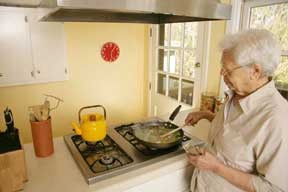
Wear short or tight-fitting sleeves when cooking.
Fires resulting from cooking continue to be the most common type of fire experienced by U.S. households. Cooking fires are also the leading cause of civilian fire injuries in residences. These fires are preventable by simply being more attentive to the use of cooking materials and equipment.
Safe Cooking Tips:
•Never leave boiling, frying, or broiling food unattended. Stay in the kitchen! If you leave the kitchen for even a short period of time, turn off the stove.
•Regularly check food that is cooking; use a timer to remind yourself that you are cooking.
•Keep anything that can catch fire – oven mitts, wooden utensils, food packaging, towels, or curtains – away from your stovetop.
•Keep the stovetop, burners, and oven clean.
•Wear short, close-fitting, or tightly rolled sleeves when cooking. Loose clothing can dangle onto stove burners and can catch fire if it comes in contact with a gas flame or electric burner.
•Have a "kid-free zone" of at least 3 feet around the stove and areas where hot food or drink is prepared or carried.
•Always use cooking equipment that has the label of a recognized testing laboratory, such as Underwriters Laboratories.
•Follow manufacturer's instructions and code requirements when installing, cleaning, and operating cooking equipment.
•Plug microwave ovens or other cooking appliances directly into an outlet. Never use an extension cord for cooking appliances as it can overload the circuit and cause a fire.
•Check electrical cords for cracks, breaks, or damage.
Smoking Safety
Soak cigarette butts and ashes in water before throwing them away.
Every year almost 1,000 smokers and non-smokers are killed in home fires caused by cigarettes and other smoking materials. The U.S. Fire Administration is working to help prevent home fire deaths and injuries caused by smoking materials. Fires caused by cigarettes and other smoking materials are preventable. You can make a difference!
Smoking and Home Action Steps:
•If you smoke, smoke outside.
•Wherever you smoke, use deep, sturdy ashtrays.
•Make sure cigarettes and ashes are out.
•Check for cigarette butts in furniture or on the floor.
•Never smoke in a home where oxygen is used.
•If you smoke, fire-safe cigarettes are better.
•Be alert!
Heating Safety
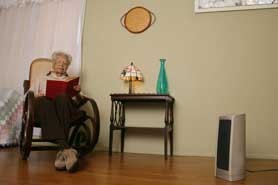
Keep space heaters at least 3 feet away from anything that can burn - including furniture, blankets, curtains, and paper products.
More than one-third of Americans use fireplaces, wood stoves and other fuel-fired appliances as primary heat sources in their homes. Unfortunately, many people are unaware of the fire risks when heating with wood and solid fuels.
Heating fires account for 36% of residential home fires in rural areas every year. Often these fires are due to creosote buildup in chimneys and stovepipes. All home heating systems require regular maintenance to function safety and efficiently.
The U.S. Fire Administration encourages you to practice the following fire safe steps to keep those home fires safely burning. Remember, fire safety is your personal responsibility…..Fire Stops with YOU!
Keep Fireplaces and Wood Stoves Clean
•Have your chimney or wood stove inspected and cleaned annually by a certified chimney specialist.
•Clear the area around the hearth of debris, decorations and flammable materials.
•Always use a metal mesh screen with fireplaces. Leave glass doors open while burning a fire.
•Install stovepipe thermometers to help monitor flue temperatures.
•Keep air inlets on wood stoves open, and never restrict air supply to fireplaces. Otherwise you may cause creosote buildup that could lead to a chimney fire.
•Use fire-resistant materials on walls around wood stoves.
Electrical Safety
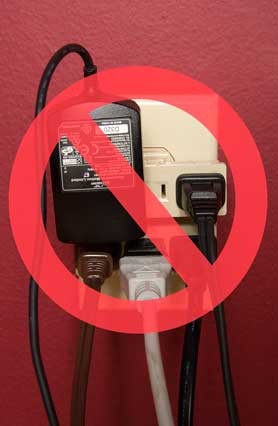
Don't overload extension cords or wall sockets.
Electrical fires in our homes claim the lives of 485 Americans each year and injure 2,305 more. Some of these fires are caused by electrical system failures and appliance defects, but many more are caused by the misuse and poor maintenance of electrical appliances, incorrectly installed wiring, and overloaded circuits.
Electrical Safety Precautions:
•Routinely check your electrical appliances and wiring.
•Frayed wires can cause fires. Replace all worn, old or damaged appliance cords immediately.
•Use electrical extension cords wisely and don't overload them.
•Keep electrical appliances away from wet floors and counters; pay special care to electrical appliances in the bathroom and kitchen.
•When buying electrical appliances look for products evaluated by a nationally recognized laboratory, such and Underwriter's Laboratories (UL).
•Don't allow children to play with or around electrical appliances like space heaters, irons and hair dryers.
•Keep clothes, curtains and other potentially combustible items at least three feet from all heaters.
•If an appliance has a three-prong plug, only use it in a three-slot outlet. Never force it to fit into a two-slot outlet or extension cord.
•Never overload extension cords or wall sockets.
•Immediately shut off, then professionally replace, light switches that are hot to the touch and lights that flicker.
•Use safety closures to "child-proof" electrical outlets.
•Check your electrical tools regularly for signs of wear.
Escape Plans
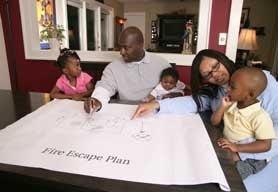
Involve children in making and practicing your escape plan.
In the event of a fire, remember - time is the biggest enemy and every second counts! Escape plans help you get out of your home quickly. In less than 30 seconds a small flame can get completely out of control and turn into a major fire. It only takes minutes for a house to fill with thick black smoke and become engulfed in flames.
Practice Escaping From Every Room In The Home
Practice escape plans every month. The best plans have two ways to get out of each room. If the primary way is blocked by fire or smoke, you will need a second way out. A secondary route might be a window onto an adjacent roof or a collapsible ladder - evaluated by a nationally recognized laboratory such as Underwriters Laboratories (UL) - for escape from upper story windows. Make sure that windows are not stuck, screens can be taken out quickly, and that security bars can be properly opened. Also, practice feeling your way out of the house in the dark or with your eyes closed.
In conjunction with Fire Prevention Week the Honey Brook Fire Company is having an open house on Saturday October 10th, 2009. Firefighters and EMT's will be on hand to answer any questions and to show how our equipment is used. There will be equipment displays and demonstrations including a visit by Skycare aeromedical helicopter(pending no emergency calls), fire extinguisher training, child fingerprinting station, and vehicle rescue show.
The open house will be held fom 1 pm to 4 pm. |