By Justin Finneran
Editor@TriCountyRecord.com
Journal Register News Service
In early February 2012, the Honey Brook Fire Company (HBFC) was notified that it was awarded $63,650 from the Federal Emergency Management Agency (FEMA) in the form of a 2011 Assistance to Firefighters Grant Program.
The primary goal of the grant is to meet the firefighting and emergency response needs of fire departments and nonaffiliated emergency medical service organizations. According to FEMA's website, the Assistance to Firefighters Grant Program has "helped firefighters and other first responders to obtain critically needed equipment, protective gear, emergency vehicles, training, and other resources needed to protect the public and emergency personnel from fire and related hazards" since the grant was established in 2001.
The Assistance to Firefighters Grant (AFG) is a wonderful boon to the HBFC. Typically, funding for operational equipment and training come through the Honey Brook Fire Company Relief Association, which essentially comes through the State of Pennsylvania. However, there are instances when there is something which the Relief Association cannot or will not be able to cover, and when borough and township funding or HBFC's own fundraising efforts (fundraising which is very time intensive – with 695 man hours put into fundraising in February alone) cannot get enough to afford the big purchases, the HBFC has to do without. Fortunately, FEMA was able to lend a major helping hand.
"We submitted (an application) last year and it takes them about four to five months to start awarding grants," said HBFC Deputy Chief Bob Klinger, "We were picked early, in either the fourth or fifth (weekly) round, so it did not take too long."
According to Klinger, the funding will be used to help replace outdated hydraulic rescue tools and airbag lifting systems. The HBFC has yet to make any actual purchases, but is going through the process of accepting bids from three major manufacturers.
"Once we choose one manufacturer to go with, then the paperwork process with the federal government begins and the funding comes through," Klinger said. "The new equipment systems will be more powerful, lighter, and safer. On average we respond to anywhere from five to ten incidents per year in and around Honey Brook that require us to utilize the rescue tools to help extricate victims from vehicles and machinery."
The HBFC, which numbers sixty volunteers as well as twenty members in the ambulance service, responds to over 70 accident calls per year.
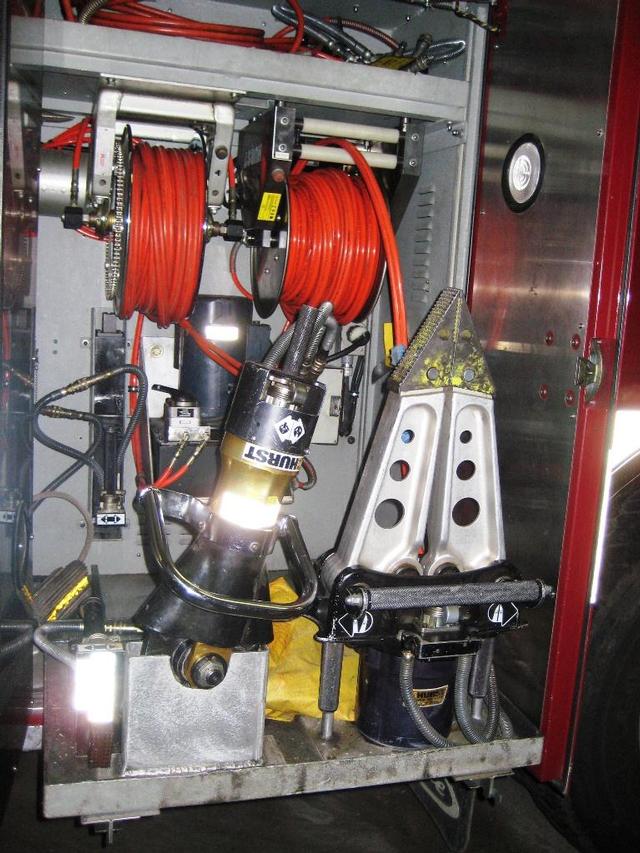
The HBFC is looking at making one major purchase to replace the systems it currently has. In terms of hydraulic rescue tools the HBFC currently has one spreader (a.k.a. The Jaws of Life) - a v-shaped tool which can both compress and push apart metal, two pairs of cutters - heavy duty shears for cutting things such as windshield posts, two combination spreader/cutters, seven rams – a cylinder often used to push apart or lift dashboards, and four power units (portable and fixed to vehicles) to power the hydraulic pumps which drive the equipment.
"Some of them are tools which were purchased from an organization called Brandywine Manor Rescue, which went defunct in the mid-80s, so some of our youngest tools are twenty years old," said Klinger, "(The equipment) still works, there is not a lot wrong with it, but it is old, it is heavy, and it is technically past its service life. The technology has just drastically improved. We are pretty much doing a one for one swap (with the new purchases). There are some different tools out there as well, but we do not have the call volume to (justify) the need for them."
Klinger said that hydraulic rescue tools were originally developed for getting racer car drivers out of wrecked cars. When firemen saw the equipment in action they knew immediately that it had real-world rescue applications. By the mid-nineties, the equipment was beginning to be commonplace in busy departments.
"When we are using these tools, primarily (at the scene of vehicle accidents), it typically means that the person inside of the car cannot get out of the car," Klinger said, "Usually this is because the metal is folded over or broken, like when a door has been impacted and cannot open or when a car has been severely mangled, and in order to have to remove the individual we have to take the doors off or push the dashboard out of the way. Our primary goal when dealing with a patient (in that type of situation) is to protect their spine and their (cervical spine) – those are the most impacted during an accident- so we do not want the patient moving at all so we have to extricate the patient from the car be removing the car around them."
He said that other incidents where the equipment would be used include building collapses, industrial machinery rescues, and when rescuing one of their own on the scene of a fire or accident.
"We also use them with the RIT (Rapid Intervention Team), which is a group of firefighters who focus on firefighter rescue – so if one of our guys gets in trouble, they are the group which will focus on getting them out."
The other major replacement for HBFC through the AFG will be a new airbag lifting system.
"(What we have now) are basically thin, tough, rubber bags that you can put down when someone is trapped underneath a vehicle or a piece of machinery," said Klinger. "We use high pressure lines (to) inject air into the bag and lift whatever it is off of the ground within the weight (specifications of each particular) bag."
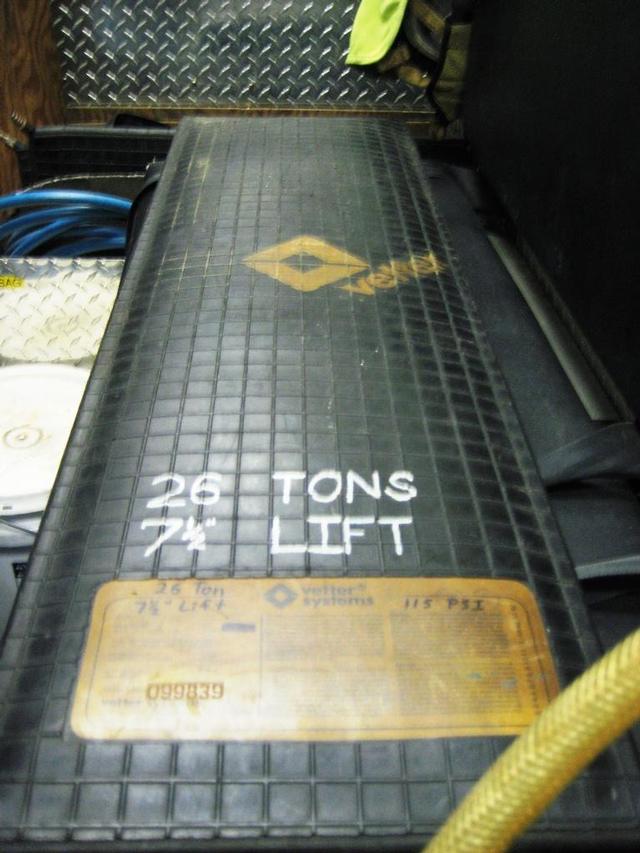
Klinger displayed one airbag which was approximately three feet by three feet, and can lift up to 34 tons 14.5 inches off of the ground. HBFC has two of the 34 ton bags as well as a few other smaller bags (another example shown was a narrow 26 ton weight bag with a 7 ¼ inch lift).
The system consists of the bags, a hose system, a hand-operated control box used for inflating and deflating, and a pressure regulator that ties into either the backpack-style cylinders which the firemen use for personal air or to one of the four 6000 psi bottles on their truck.
When the bags are deployed, the HBFC uses a 'lift and inch, crib and inch' method – where wooden blocks or 'cribbing' are used to stabilize the item being lifted.
"It's not like you see in Hollywood where they lift something up and just yank someone out. It is very, very controlled," Klinger explained.
The new lift systems are based on the same design and concept, but will have lighter and sturdier airbags which are Kevlar reinforced and can take more abuse. The control box will also be smaller and lighter.
"We can puncture the rubber bags we have now if we are not careful, so we use sheets of plywood to protect the bags. We purchased our bags from Morgantown in the early 2000s – so these are at the end of their life expectancy."
Both the new hydraulic tools and airbag lift systems will allow for HBFD to share components of their systems with the up-to-date systems used by neighboring emergency service teams – a convenience absent with their existing system. The cross compatibility could save lives when HBFC is faced with incidents where there are a lot of injuries, such as bus accidents.
"A lot of people have gone on to the newer high pressure hydraulic tools and newer air bags and the systems are not compatible (with ours)," said Klinger. "When we are dealing with a lot of work rescue-wise, where we would absolutely have to have a surrounding rescue department come out and assist us, our goal is to be able to basically hand one of their guys a tool and he would be able to use it. We can already do it with (water hoses)."
Once the HBFC gets their new equipment, Klinger said that eight to ten hours of hands-on and classroom training will be required in order for an individual to become certified in operation of the gear.
"We will probably go up to a junkyard and just tear apart as many cars as they can give us."
As far as the fate of the outgoing equipment, Klinger said that there are a few options on the table.
"The chief and I have established some contacts in our visits to the National Fire Academy, including some departments out in midwestern Pennsylvania who aren't nearly as lucky as the southeastern Pennsylvania region with money and have budgets (that are almost two-thirds less than HBFCs)," Klinger explained. "We are getting ready to do a big donation to (a department) out there, we have some old turnout gear and some other old equipment, so we are looking at maybe giving them some of this stuff and seeing if they can use it. We are either (donating the equipment or) looking at trading some of the stuff in to get cash back."
There are other upgrades that HBFC has recently made, or are coming soon, outside of the FEMA funding. One is a new data gathering and tracking system called Firehouse Software, which is a web-based program that tracks every aspect of activity in the HBFC and places it into easily digestible reports. The reports are also shared through the internet on county, state and national levels.
"Every year the federal government issues a report that says 'there were this many fire deaths, this many firefighters injured, etc. This program is where all of that data comes from," Klinger explained.
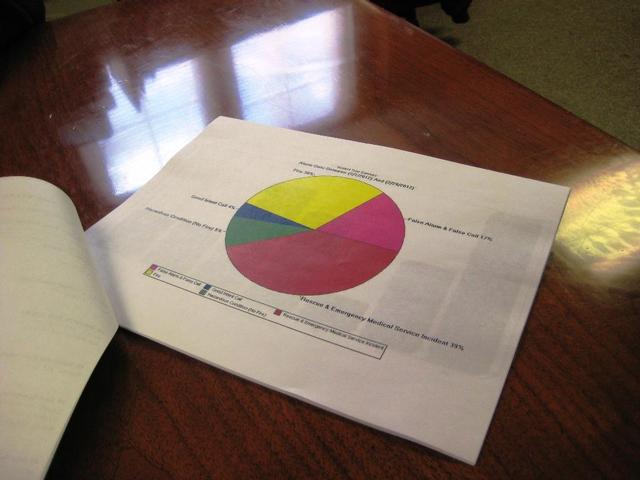
The software lets the HBFC amass detailed information including, but not limited to, the number of calls in a given time period, the municipalities that HBFC responded in, the total time spent on calls by type, the assistance to/from neighboring departments, the days of the month which are the busiest, the average personnel turnout per call, a run sheet of who made how many calls, an account of each unit which responds to a given incident, and staff activity such as fundraising, training, standby, community meetings, and officers meetings.
Klinger said that HBFC had "a lot of problems" with the old reporting computer system, so last year he did some research and found the upgrade. The cost of the upgrade was approximately $9,000 and was paid for through a separate grant from the Pennsylvania State Fire Commissioner.
"Before we had to write the information down on a piece of paper and do the math ourselves, so the tracking is a very outstanding feature."
The remaining money from the Commissioner's grant will go towards a new duty vehicle which will soon be seen around the area.
Also forthcoming this year from the county will be new radio and paging systems.
"The radio system is owned by the county. It went live around 2000 and is approaching the end of its 'shelf life'," Klinger said, "They are heavily investing in a new system which will (provide) better coverage for us… …and we are also getting an updated paging system."
The paging system is a receive-only communication sent out from the county which informs responders to the type of emergency, the location, who is responding, etc., whereas their radio system is two-way communication for both HBFC internal communications among vehicles and the station, as well as for back-and-forth communication between HBFC, other emergency service responders, and the county dispatch.
"We have some frequencies that are local only which we use on the fire ground, so guys from – for example Phoenixville – do not have to listen to our calls. Back in the fall of 2011 there were five house fires going on at the same time in Chester County. That is a lot of radio chatter.
http://www.berksmontnews.com/articles/2012/03/07/tri_county_record/news/doc4f57a14f2b038344141582.txt?viewmode=fullstory (opens in a new tab) |





 Add a Comment
