Child Passenger Safety Week is Sept. 15 to 21, and Honey Brook Fire Company joins the Pennsylvania Department of Transportation to remind families of the importance of correctly securing children in an appropriate child safety seat, booster seat, or seat belt when riding in the family vehicle. Did you know that Honey Brook Fire Company has two Child Passenger Seat Technicians on staff who are available to inspect and install car seats?
The theme for Child Passenger Safety Week 2013, "Right Seat-Buckled Tight!" reminds parents and caregivers to select the correct child safety restraints (rear-facing, forward-facing, booster, seat belt) for their child's age and size and to properly secure their children on every trip - every time. The National Highway Traffic Safety Administration (NHTSA), found that parents make significant mistakes when using car seats and boosters for children, with a full 20 percent failing to read instructions on how to properly install safety restraints.
The five most significant mistakes observed are:
1. The harness straps used to hold the child in the seat are either too high or too low, instead of over the shoulders.
2. The chest clip is positioned over the abdomen or not used at all.
3. The child seat itself moves more than two inches in any direction. Anything more than one inch is too much.
4. The harness has more than two inches of slack between the child and the harness straps. There should be no slack.
5. In booster seats, the seat belt placement is wrong, with either the lap belt resting over the stomach instead of the hips or thighs, or the shoulder belt resting across the child's neck or face instead of in the middle of the shoulder.
On an average day in Pennsylvania, there are about 340 reportable crashes on state highways. Research found that using the correct car seat reduces the chance of fatal injury by 71 percent for infants and 54 percent for toddlers. Children who are correctly buckled in a child safety seat, booster seat or seat belt benefit from the single most effective way to protect motor vehicle occupants and reduce fatalities in a crash. From 2008 - 2012, 81 percent of the children under age 4 who were involved in crashes and restrained in a car seat sustained no injury.
Child passenger safety includes all children from birth through teenage drivers. The American Academy of Pediatrics provided best practice recommendations for the use of car seats, booster seats, and seat belts for children of all ages. These recommendations are evidence-based, and Child Passenger Safety Week provides the perfect opportunity to evaluate the safety of the entire family in the family vehicle.
Here are some key safety recommendations to help families protect their children in the vehicle:
- Restrain all adults and children on every trip - every time. Parents who buckle up set the example and teach children to buckle up. In 2012, there were 124,092 reportable traffic crashes in Pennsylvania. These crashes claimed the lives of 1,310 people and injured and another 87,846 people.
- Keep your child in a back seat. Children are 38 percent less likely to be injured in a crash if they are in a back seat (Children's Hospital of Philadelphia - Partners for Child Passenger Safety).
- Use child safety seats and seat belts correctly. There is still a high misuse rate of child safety seats and booster seats.
- Use the best safety restraint for your child's size. Take into account a child's age, weight, height, physical development and behavior needs when selecting a seat.
The American Academy of Pediatrics recommendations listed below are a good way to help determine which type of child safety seat is best for your child.
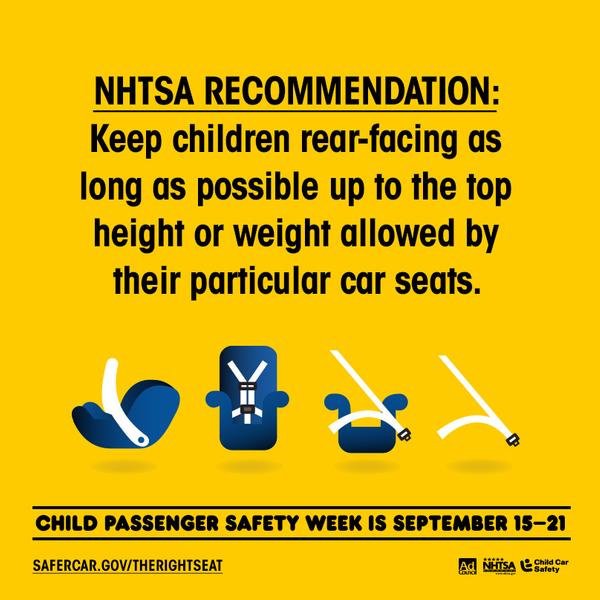
- All infants and toddlers should ride in a rear-facing car safety seat (CSS) until they are 2 years of age or until they reach the highest weight or height allowed by the manufacturer of their CSS.
- All children 2 years or older, or those younger than 2 years who have outgrown their rear-facing weight or height limit for the CSS, should use a forward-facing CSS with a harness for as long as possible, up to the highest weight or height allowed by the manufacturer of their CSS.
- All children whose weight or height is above the forward-facing limit for their CSS should use a belt-positioning booster seat until the vehicle lap-and-shoulder seat belt fits properly, typically when they have reached 4 feet 9 inches in height and are between 8 and 12 years of age.
- When children are old enough and large enough to use the vehicle seat belt alone, they should always use lap-and-shoulder seat belts for optimal protection.
Under Pennsylvania's child passenger safety law, all drivers are responsible for securing children in the appropriate child restraint system. All children from birth up to age 4 must be secured in an approved child safety seat anywhere in the vehicle. All children age 4 up to age 8 must be secured in a seat belt system and appropriate child booster seat anywhere in the vehicle. All children age 8 up to age 18 must be secured in a seat belt system anywhere in the vehicle. Under Pennsylvania's seat belt law, all drivers are responsible for the front seat occupants to wear a properly adjusted and fastened seat belt system. All drivers under 18 years of age may not operate a motor vehicle in which the number of passengers exceeds the number of available safety seat belts in the vehicle.
# # #
If you are unable to afford a car seat,
call 1-800-CAR-BELT or visit www.pakidstravelsafe.org
to find the nearest car seat loan program,
child safety seat inspection station or car seat check up event.
If you would like more information, please call 1-800-CAR-BELT or to schedule an interview with EMT Lenny Brown or EMS Captain Chaz Brogan, please call (610) 273-2539 or email at lbrown@honeybrookfire.org or cbrogan@honeybrookfire.org. |


 Add a Comment
